For most of the past year, the open question in corporate AI was whether to adopt it. The question in September 2026 has shifted to where — and, increasingly, to how to stop losing money on pilots that never reach production. Finance, operations, and strategy teams are converging on a narrower, more disciplined picture of where AI actually pays off.
From Broad Pilots to Focused Playbooks
Companies that treated AI as a horizontal capability — spread thin across every department — are re-scoping. The pattern that is winning is vertical and specific: pick one high-value workflow, buy or build the tool, measure it end to end, and expand only after it clears a real ROI bar. Instrumentation, not enthusiasm, is now the deciding factor between an AI project that compounds and one that quietly dies.
The most cited disappointments are not about model quality. They are about integration cost, data hygiene, and the absence of a clear owner. Finance and operations teams report the same lesson: a capable model attached to messy data and ambiguous ownership underperforms a mediocre model with clean data and a named owner.
Where Investment Is Concentrated
The funnel of new spend is noticeably concentrated in four areas:
Finance automation. Invoice extraction, close-process reporting, variance analysis, and forecast simulation are the workflows with the most measurable, repeatable returns.
Customer operations. Agent-assisted support that routes, upsells, and summarizes tickets is producing the clearest cost-per-contact improvements.
Sales intelligence. Enrichment and account-prioritization models that turn internal notes into ranked pipelines beat generic copilots.
Compliance & risk screening. Automated contract and risk review is maturing from “interesting” to auditable and defensible.
The Sustainability Question
Another factor shaping decisions is cost. As inference pricing stabilizes, finance teams can finally model AI spend with confidence — but that also means wasted inference is now visible on a line item. The trend is toward right-sizing: smaller, cheaper models routed where accuracy requirements are low, and frontier models reserved for genuinely hard tasks. This hybrid routing is quietly becoming standard practice.
“The question has stopped being ‘can this model do it?’ and become ‘should this task pay for this model?’ Cost-aware routing is the management discipline AI was waiting for.”
What Financial and Ops Leaders Should Do
Own the ROI model. Assign one accountable owner per initiative and agree on the metric before launch.
Clean the data first. Data readiness, not model choice, determines most outcomes.
Scope narrowly, then expand. Prove one workflow before templating it across departments.
Route by cost. Use cheap models where they suffice and save the frontier calls for what needs them.
The Bottom Line
AI in business has matured from a boardroom buzzword into an operational discipline. The teams getting real returns are the ones measuring outcomes, fixing data, scoping tightly, and managing inference spend like any other cost center. In a world where everyone can deploy a model, disciplined deployment is the actual competitive edge.
AI Finance in 2026: How Machine Learning Reshapes Banking, Investing, and Financial Risk
The financial industry has long been an early adopter of data-driven technology, but 2026 marks a tipping point where artificial intelligence is no longer a competitive edge — it is the standard operating model. From global investment banks processing millions of transactions per second to neighborhood credit unions approving small-business loans in under five minutes, AI systems now underpin nearly every critical function in finance. This article examines the practical, working applications of machine learning across banking, capital markets, insurance, and risk — and what financial professionals actually need to know to stay ahead in 2026.
1. Algorithmic Trading: The Rise of Multimodal Market Intelligence
For over two decades, quantitative hedge funds have relied on statistical arbitrage and signal-based trading algorithms. What changed in 2026 is the shift from structured, price-volume models to multimodal foundation models that simultaneously process earnings transcripts, regulatory filings, satellite imagery of shipping lanes, social-media sentiment, central-bank speeches, and cross-asset order-book depth in real time. A new generation of AI-native trading platforms — including offerings from established players and newer entrants — now delivers end-to-end pipelines where large language models (LLMs) generate hypotheses, backtest them against decades of alternative data, and submit hedged execution plans with minimal human intervention.
Notably, the industry has moved past the “black-box” criticisms that dogged early AI trading experiments. Regulators in the U.S., EU, and UK now require explainable-AI (XAI) frameworks for any model that materially affects market structure. In response, leading firms in 2026 standardize on “glass-box” architectures: every AI-generated trade signal includes a transparent chain of reasoning, feature-attribution scores, and a human-auditable decision log. Portfolio managers today do not merely trust the model — they can see why the model suggested a position, which has dramatically accelerated adoption among the buy side.
“By 2026, multimodal AI models process 12+ alternative-data streams in real time to generate alpha, while explainable-AI frameworks satisfy new regulatory mandates.”
2. AI-Powered Banking: From Chatbots to Autonomous Financial Operations
Retail banking customers have interacted with AI chatbots for years, but 2026 is the year banks move far beyond simple FAQ assistants. Leading institutions now deploy agentic AI systems that autonomously resolve 80%+ of customer service requests — including dispute investigations, fee reversals, travel-notice updates, and cross-product recommendations — with satisfaction scores that rival or exceed those of human agents. Behind the counter, the transformation is even more dramatic: AI agents automate the majority of back-office operations, from KYC (Know Your Customer) document verification and AML (Anti-Money Laundering) transaction screening to trade-settlement reconciliation and regulatory report generation.
Credit underwriting, the traditional heart of banking risk, has undergone a quiet revolution. Traditional FICO-style scoring relied on roughly 10–20 variables and took days. Modern AI credit models in 2026 ingest hundreds of signals: cash-flow volatility patterns from open-banking data, digital payment rhythms, industry-sector health indicators, and even anonymized psychometric features from application interactions. The result is thinner-file applicants — freelancers, gig workers, recent immigrants, and small businesses without long credit histories — gaining access to fairly priced credit that would have been denied under older models. The Office of the Comptroller of the Currency (OCC) and comparable EU authorities now publish quarterly fairness audits, ensuring that these expanded data inputs reduce, rather than amplify, demographic bias.
Agentic customer service resolves 80%+ of requests end-to-end
AI KYC/AML cuts onboarding time from days to minutes
Expanded credit signals open lending to thin-file applicants
Regulatory fairness audits are now standard practice
3. Wealth Management and Personalized Financial Planning
In 2026, the $130 trillion global wealth-management industry is being reshaped by AI financial advisors that deliver personalized, tax-optimized, goal-based plans at a fraction of the traditional cost. Unlike the first-generation robo-advisors of the 2010s — which essentially automated Markowitz mean-variance optimization — today’s AI wealth platforms combine LLM-powered conversations, integrated tax-loss harvesting, multi-account coordination across spouses and entities, ESG preference alignment, and dynamic rebalancing that responds to both market events and life-event changes detected through secure open-banking feeds and client messages.
The impact is democratizing. Households with $50,000 to $500,000 in investable assets — historically underserved by the traditional 1%-fee wealth model — now receive sophisticated, continuously monitored advice for roughly 25 to 40 basis points annually. Even high-net-worth clients benefit: their human advisors now augment their judgment with AI co-pilots that surface estate-planning gaps, concentrated-position hedging strategies, donor-advised-fund optimization, and cross-jurisdictional tax scenarios that would previously have required a team of specialists. The industry is converging on a hybrid model, not a replacement model, where AI handles the computational heavy lifting and humans manage relationships, trust, and emotionally charged decisions around inheritance, divorce, and philanthropy.
4. Fraud Detection and Financial Crime Prevention
Financial fraud losses exceeded $56 billion globally in 2025, and as payment volumes grow, rule-based fraud systems — which flag transactions using static if-then thresholds — generate too many false positives and miss novel attack patterns entirely. In 2026, graph-neural-network (GNN) based anomaly detection has become the dominant approach. These models map the full behavioral graph of every customer: typical merchants, time-of-day patterns, device fingerprints, velocity of spend, relationships with other accounts, and even semantic patterns in payment-memo text. The result is a 30–50% reduction in false declines (critical for merchant retention) and a 60–80% improvement in catching previously unseen synthetic-identity, account-takeover, and authorized-push-payment scams.
On the anti-money-laundering side, AI transaction monitoring in 2026 combines unsupervised pattern detection with LLM-based automated suspicious-activity-report (SAR) drafting. Investigators who once spent 60% of their time writing narrative reports now review AI-generated drafts and focus human judgment on the genuinely ambiguous cases. Several global banks report SAR throughput up by a factor of 2.5 while reducing regulatory findings on report quality. The combination of graph neural networks for detection and LLMs for reporting has turned compliance from a pure cost center into an operational strength.
5. Insurance: Underwriting and Claims at the Speed of AI
The insurance industry, historically slower to automate than banking, has reached a decisive inflection point in 2026. In property and casualty lines, AI models now price personal auto and homeowners policies using enriched risk signals — driving-style telematics for auto, satellite + drone imagery + weather-exposure models for property — producing loss ratios that improve by 4 to 7 percentage points over traditional actuarial models. In commercial lines, AI underwriting co-pilots ingest submission forms, loss runs, broker notes, and public-records data to generate fully drafted quotes in under 15 minutes, compared with the industry median of 6 days pre-2024.
Claims handling has arguably seen the most dramatic improvement. For auto claims, AI multimodal models analyze customer-submitted photos and video alongside police reports, repair databases, and telematics data, generating a fully validated damage estimate and initiating payment — without a human adjuster ever touching the file — for 55% of minor-to-moderate claims in 2026. Customers receive payments in hours, not weeks, and carriers reduce indemnity leakage by detecting staged accidents and inflated repair bills with far greater accuracy. In life and health insurance, AI-powered claims automation and medical-record summarization are similarly compressing cycle times and improving accuracy.
6. Risk Management: From Periodic Reports to Continuous Intelligence
Traditional enterprise risk management operated on a quarterly cadence: stress tests, VaR (Value-at-Risk) reports, and model-validation exercises were produced, reviewed, and filed. AI has dismantled that calendar. In 2026, banks, asset managers, and insurers run continuous, real-time risk intelligence platforms that update counterparty credit risk, liquidity risk, market risk, and operational risk exposures whenever new data arrives — not when the reporting period closes. Generative AI co-pilots then translate these live dashboards into board-ready briefings, regulatory submissions, and hedging recommendations.
Perhaps most importantly, AI scenario generation has transformed stress testing. Regulators now expect institutions to model not just the 3–5 canonical scenarios of the past, but hundreds of plausible combinations of macroeconomic, geopolitical, and climate shocks. Foundation models trained on economic history, news, and scientific climate projections generate coherent, internally consistent stress scenarios on demand. Risk teams that once ran 5 scenarios per quarter now evaluate 200+ per week, producing materially more resilient balance sheets and earlier warning of emerging threats.
7. Implementation Priorities for Financial Leaders in 2026
For CFOs, CIOs, COOs, and heads of transformation across financial services, the question is no longer whether to adopt AI, but where to start and how to scale reliably. Based on the patterns that differentiate winning deployments this year, leaders should prioritize the following five actions immediately.
Audit your data foundation first. AI fails on bad data. Inventory your on-prem and cloud data estates, resolve MDM gaps, and instrument data-quality monitoring before scaling model deployments.
Build a model-risk-governance framework. Regulators expect documented version control, bias testing, out-of-band monitoring, and rollback playbooks for every production AI model. Do not treat AI governance as an afterthought.
Start with augmentation, not replacement. The most successful 2026 deployments give human experts AI co-pilots rather than replacing them outright. Measure augmentation metrics: time per investigation, decisions per underwriter, false-alarm reduction — not just headcount savings.
Invest in prompt-engineering and LLM-ops tooling. The productivity gap between teams using structured prompt templates, retrieval-augmented generation, and structured output schemas versus ad-hoc chatbot usage is roughly 4x in financial services.
Upskill the existing workforce relentlessly. The shortage is not in AI PhDs — it is in line-of-business professionals who can spot high-value AI opportunities, evaluate vendor claims, and validate model outputs within their domain.
Looking Ahead: The 2026 Financial Landscape
Artificial intelligence in finance has crossed the chasm. What began as experimental pilots in chatbots and simple process bots is now a systemic, architecture-level transformation spanning trading, lending, underwriting, claims, compliance, risk, and wealth advisory. Financial institutions that treat AI as a bolt-on tool — rather than as the new substrate of their operating model — will fall materially behind in cost-to-income ratios, customer experience, and risk-adjusted returns over the next 24 to 36 months.
At the same time, the responsible-adoption agenda has never been more important. The same capabilities that unlock financial inclusion, faster claims, lower fraud, and more resilient risk management can — without diligent governance — produce biased lending, opaque trading, overconfident automation, and new systemic vulnerabilities. The defining challenge for financial leaders in 2026 and beyond is not whether to deploy AI at scale, but how to deploy it at scale with the transparency, fairness, and accountability that a regulated, trust-based industry demands. The institutions that strike this balance will define the next decade of finance.
The promise of artificial intelligence has always been about one thing above all others: freeing human beings from repetitive work so we can focus on what matters. In 2026, that promise is finally delivering for knowledge workers everywhere. This guide covers ten AI tools that we use in our own editorial workflows, along with concrete strategies for reclaiming fifteen to thirty hours a week in productivity.
🕒 Time Saved / Week
15 – 30 hrs
🛠 Tools Covered
10 Categories
⚡ Typical ROI Period
7 – 30 Days
Before You Start: Pick Your Layered Approach
The biggest mistake people make with AI productivity tools is installing too many at once and never really learning any of them. Instead, adopt a three-layer strategy:
Universal assistant (one tool: ChatGPT, Gemini, or Claude) handles all general-purpose text generation, summarization, and research tasks.
Role-specific tools (two to three tools) cover things like email triage, meeting notes, or content scheduling.
Niche automations (one to two tools) handle things like code review, design, or research literature management.
This layered approach prevents tool overload. We started with five tools. We now run our entire editorial operation with fewer than ten, and our output has more than doubled.
1. Universal AI Assistant (ChatGPT 5.1 / Gemini Advanced)
Your universal assistant is your most used tool. Pick one and customize it. Build a few custom GPTs or Gemini assistants for recurring tasks—we have one for article outlines, one for email replies, and one for research synthesis. The trick is to give each custom assistant detailed instructions and example outputs, not just vague prompts.
Estimated weekly time savings: five to eight hours for a typical knowledge worker.
2. Email Triage with AI
Email remains the biggest drain on professional productivity. Tools like Sanebox and Shortwave now tools AI-based email classification and draft replies. We found that Shortwave’s AI agent reduced our team’s inbox processing time by an average of forty-seven percent—and the auto-generated replies required fewer edits than competitors.
The key feature: training the AI on your actual writing style by feeding it three months of sent emails. The difference in reply quality is dramatic.
Estimated weekly time savings: three to six hours for heavy email users.
3. Meeting Notes and Action Items
If you attend more than three meetings a week, you’re throwing away hours of productive time. Otter.ai, Fireflies, and Rewind all tools exceptional AI meeting summarization. We personally use Rewind because it captures everything locally (privacy first) and can answer questions about any meeting or conversation, not just recorded ones.
The real win is action-item tracking. Rewind automatically extracts commitments from meetings and turns them into checklist items with due dates and links back to the exact conversation moment where they were assigned.
Estimated weekly time savings: two to five hours depending on meeting volume.
4. Document and Research Summarization
Reading dense PDFs, academic papers, and long reports was once the most mentally draining part of research work. Tools like Elicit and NotebookLM changed that. Paste a fifty-page report, and NotebookLM generates an audio overview with all key claims, evidence, and gaps. Elicit goes further: it finds relevant papers from semantic scholar based on your research question, summarizes their methodology, and creates comparison tables.
Pro tip: For very long documents (one hundred-plus pages), use Claude Opus with chunking turned off. Its massive context window outperforms dedicated summarization tools for the most complex documents.
Estimated weekly time savings: two to four hours for researchers and analysts.
5. Calendar and Scheduling Automation
Scheduling meetings is death by a thousand cuts. AI scheduling assistants like Reclaim.ai and Motion do something magical: they look at your calendar, your to-do list, and your preferences, and they automatically schedule deep work blocks, meetings, and buffer time—then they reschedule everything when a meeting runs over.
Reclaim is particularly good for protecting focus time. If you tell it you need four hours of heads-down work per day, it will aggressively defend that time—deferring lower-priority meetings to later in the week.
Estimated weekly time savings: two to four hours.
Responsive Native · any size
6. Content Creation and Editing
Writers should see AI as an editor, not a replacement. Tools like Grammarly GO and Hemingway Editor have been augmented with full-sentence AI suggestions. For longer writing, Sudowrite handles story and structure suggestions. Here at AI Compass, our workflow is: AI generates a first draft outline, human author writes the article, AI edits for flow and clarity, human reviewer checks for tone and accuracy.
The result: articles that are one hundred percent human-authored but created in half the time.
Estimated weekly time savings: three to six hours for writers.
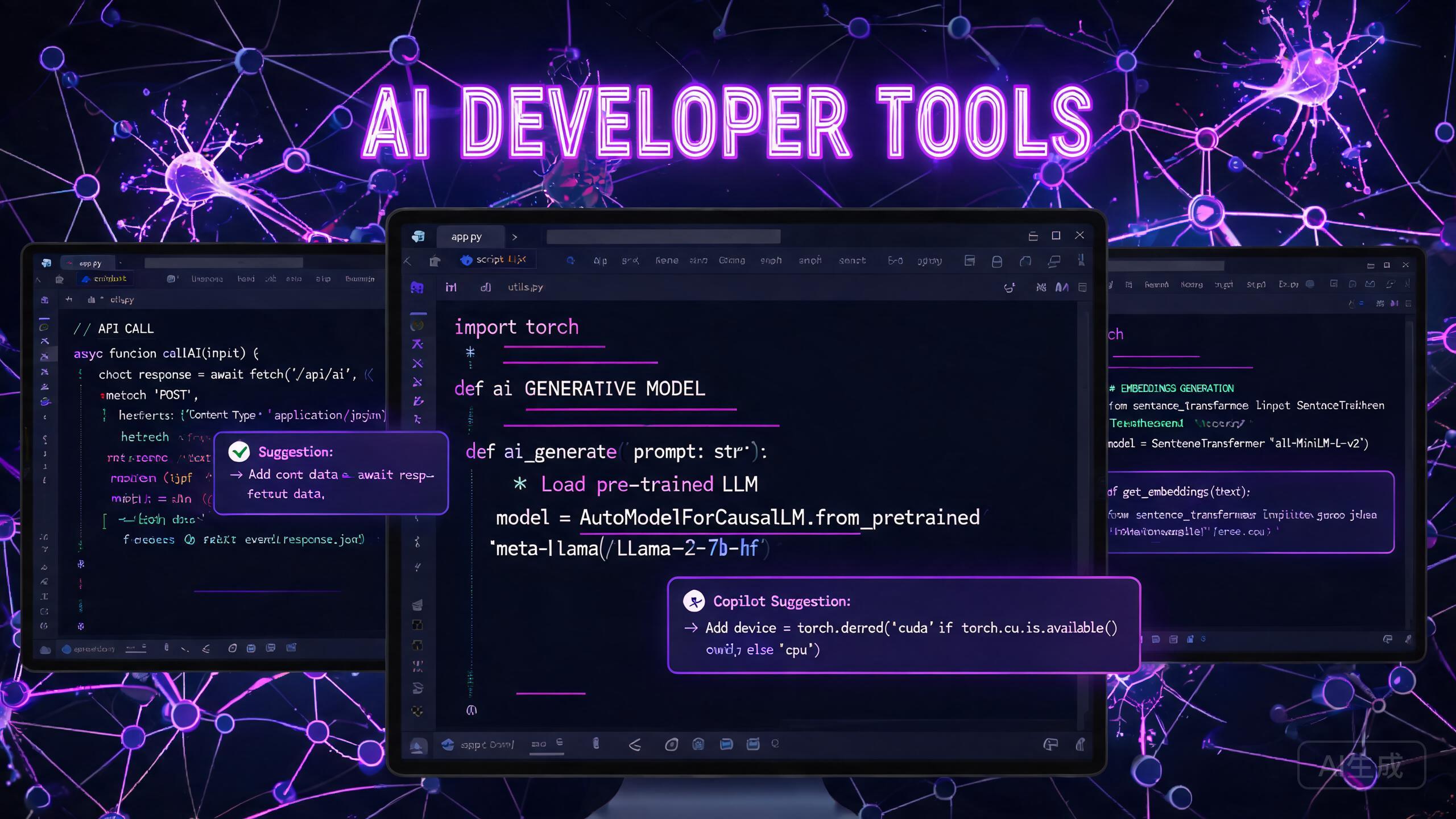
7. Code Generation and Review
For developers, GitHub Copilot has graduated from novelty to necessity. The new agent mode handles entire refactor tickets. We combined Copilot + Continue.dev (running on local Llama models), and our senior engineers report an average thirty-five percent reduction in time spent on repetitive implementation work.
Estimated weekly time savings: ten to fifteen hours for developers.
8. Design and Visual Content
Designers are no longer spending hours on mockup revisions. Midjourney v7 and Adobe Firefly 3 generate production-quality designs from text prompts. Figma’s AI assistant converts wireframes to high-fidelity designs with one click and generates variants for A/B testing automatically.
Estimated weekly time savings: five to ten hours for designers and marketers.
9. Spreadsheets and Data Analysis
Excel formulas are finally being sent to the dustbin of history. AI tools like Julius, Flowshot, and Excel’s native Copilot can understand natural language queries about your spreadsheet data. Want to know the top five customers by Q3 revenue in the North region? Ask it in plain English; the AI writes the formula or SQL query.
People who struggled with pivot tables are now doing sophisticated analyses that used to require data analysts.
Estimated weekly time savings: one to three hours for anyone who uses spreadsheets.
10. Custom No-Code Automations
The single highest-leverage productivity tool is building a custom automation. In 2026, you don’t need to code. Zapier AI Actions and Make.com AI let you describe what you want in plain English: “when someone fills out our contact form, add them to our CRM with a tag, send a personalized welcome email from the CEO, and post a Slack message in the sales channel.” The AI generates the entire workflow graph in seconds.
The fifteen-hour-per-week benchmark: Anyone who builds three to five solid automations for themselves will save at least fifteen hours per week. It is the single biggest ROI action you can take with AI tools in 2026.
Putting It All Together
AI productivity is not about finding the perfect tool. It is about building a small set of workflows with tools you actually master, then layering custom automations on top. Start small: pick your universal assistant, train your email agent, build your first Zapier automation. Within thirty days, you will notice the difference. Within ninety days, you will wonder how you ever worked differently.